"We need branding" usually means "we need a new logo". "We need marketing" usually means "we need more sales". Both requests are common, and both are often aimed at the wrong problem. A business whose customers cannot say why it is different does not need a new logo. A business nobody recognises does not need another campaign that looks different from the last one.
The three words get mixed up because they overlap and because agencies sell them together. But they answer three different questions, and paying for the wrong one is one of the most expensive mistakes a growing business makes. This article separates them, gives a table to see which one is the actual gap, and walks through an example where the request and the real problem did not match.
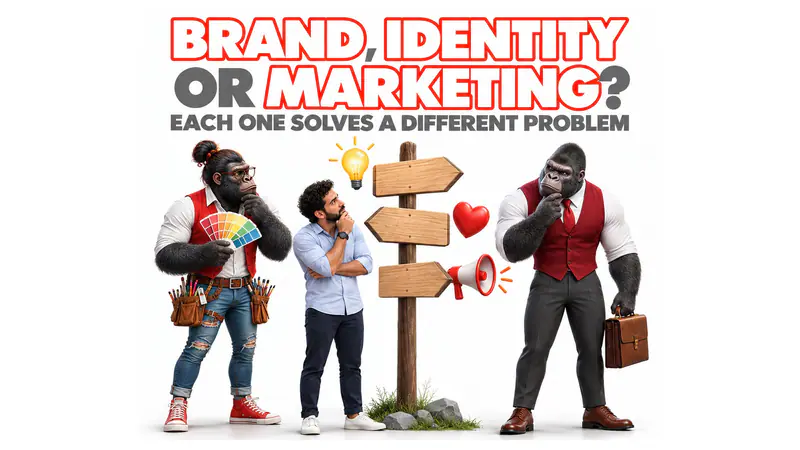
In short: The brand is what people think and feel about you, and why they would choose you; it is decided by strategy. The identity is the visible and verbal system that makes you recognisable: name, logo, colours, type, tone. Marketing is the work that gets the right people to notice you and buy. A weak brand cannot be fixed with a logo, an unrecognisable identity cannot be fixed with more ads, and a clear brand without marketing stays on paper. Find which one is weak, then fix that one first.
Three words, three jobs
The brand: the reason to choose you
A brand is not something a company owns on a hard drive. It lives in customers' heads. Kevin Lane Keller's work on customer-based brand equity ("Conceptualizing, Measuring, and Managing Customer-Based Brand Equity", Journal of Marketing, 1993) defines it in two parts: whether people know you exist, and what they associate with you, how strong, favourable and unique those associations are. Brand strategy is the work of choosing which associations to build: who you are for, what you stand against, the one thing you want to be known for. In practice it ends up as a few pages: positioning, promise, personality and proof.
The identity: how people recognise you
The identity is the set of signals that lets people recognise the brand quickly and link it to the right name: the logo, colours, typefaces, photography style, packaging shapes, the name itself and the tone of voice. Jenni Romaniuk's Building Distinctive Brand Assets (2018) makes the useful point that an asset only works when it is both unique to you and widely known to be yours, and that it takes consistent use over time to get there. Identity is the brand made visible, not the brand itself.
Marketing: how the right people find you and buy
Marketing covers the decisions and the activity that bring the brand to buyers and turn interest into sales: which customers to target, which channels, what to say this quarter, the offer and the price, the ads, the content, the follow-up. It is where most of the money is spent, which is why it is so often blamed, and so often asked to fix problems that started elsewhere.
The brand is what people say about you. The identity is how they recognise you. Marketing is how they hear about you in the first place.
A symptom table: which one is the gap?
Most businesses show signs in more than one row. Start with the row that describes what is happening most often, and check the first thing listed before spending on anything.
| What we see | Most likely gap | First thing to check |
|---|---|---|
| Customers like you but cannot say why you are different | Brand | Can the team say it in one sentence, the same way? |
| You compete mostly on price | Brand | What the customer would lose by choosing a cheaper option |
| People confuse you with a competitor | Identity | Your colours, name and style next to theirs |
| Every post and ad looks like a different company | Identity | Is there a written system, or only a logo file? |
| Few people know you, but most who try you come back | Marketing | Where new customers came from last quarter |
| Each campaign says something different | Brand, then marketing | Is there one agreed message to repeat? |
| Lots of interest, few sales | Marketing (follow-up, offer) | Where conversations stop |
The five-step check
These steps take a few days and need nothing but the team, a handful of customers and the numbers you already have. Each produces something specific.
- The problem in the customer's words. Write the business problem as a customer would describe it, not as an internal wish. "They don't know we exist" and "they know us but choose the other shop" lead to different work. Output: one sentence.
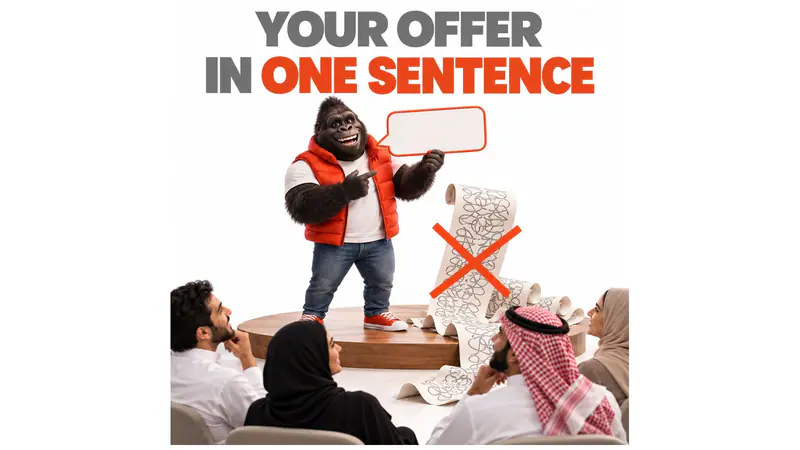
- The one-sentence test. Ask five people on the team, separately, to finish: "We are the choice for… who want… because…". Output: five sentences. If they match, the brand is probably clear inside. If they do not, the brand is the gap, whatever the logo looks like.
- The cover-the-logo test. Show five customers three of your posts or packs and three of a competitor's, with the names covered. Ask which are yours and how they knew. Output: a short list of what people actually recognise. If nothing is recognised, the identity is the gap.
- The reach-and-conversion baseline. For the last quarter: how many new enquiries, where they came from, how many bought, how many came back. Output: four numbers. Low enquiries with good conversion points to marketing reach; high enquiries with poor conversion points to the offer or the follow-up.
- One brief for one layer. Name the weakest of the three and write a one-page brief for it alone: the problem, the evidence from steps 2 to 4, and the number that should change. Output: a brief that any agency, or your own team, can work from.
A worked example
This example is hypothetical, and its numbers are illustrative. A family-run catering company in Dubai has served office events and private parties for nine years. Bookings have dropped over the past year, and the owner's request is clear: a new logo and a fresh look, because "the brand feels old".
The one-sentence test gives five different answers: "the most reliable caterer for offices", "home-style Arabic food", "flexible on menus", "good value", "we do any size". The team agrees the food is good, but not on why a client should pick them.
The cover-the-logo test surprises the owner. Four of five regular clients pick out the company's trays and serving style straight away, by the colour of the boxes and the way the mezze is arranged. The identity, old as it feels inside, is recognised.
The baseline shows where the drop is: new enquiries fell by about a third, while the share of enquiries that turned into bookings stayed roughly the same. Repeat clients are steady. The company stopped posting regularly two years ago, and newer competitors now show up first when office managers search.
The diagnosis: two gaps, neither of them the logo. The first is the brand: no agreed reason to choose them, which is why every proposal reads differently. The second is marketing reach: the right buyers no longer come across them. A new logo would have thrown away the one thing working, the recognition with existing clients, and would not have brought a single new enquiry. The brief becomes: agree one positioning for office catering, keep and tidy the existing identity, then plan steady visibility where office managers look.
Five mistakes we see most
- Rebranding to fix a sales drop. It happens because a new look is visible and feels like action. But if the drop comes from reach or the offer, a rebrand spends money and can erase recognition you built over years. Check the baseline first; see also before changing your logo.
- Treating the logo as the brand. A logo is one asset among many. A beautiful logo on a business with no clear reason to choose it is still a business with no clear reason to choose it.
- Marketing without an agreed brand. Each campaign is briefed fresh, so each says something new, and nothing adds up in customers' memory. Agree the message first, then vary the execution.
- A brand strategy nobody uses. A long document is written, approved and filed. If the sales team, the designer and the person writing captions cannot use it tomorrow, it is too long or too vague. One page that everyone uses beats fifty that nobody opens.
- Changing the identity too often. New colours every season feel fresh inside the company and look like a stranger outside it. Recognition is built by repetition, so tidy and extend what works before replacing it.
The strongest objection
"We are a small business. Brand strategy is for big companies." Every business already has a brand: whatever its customers say about it when it is not in the room. The only question is whether it was chosen or left to chance. For a small business the work is small too: a clear sentence about who it is for and why, said the same way everywhere. That costs much less than a year of campaigns pulling in different directions.
Honest limits
None of the three fixes a weak product, poor service or broken delivery. If customers try you and do not come back, look there first. In some markets, such as commodity supply sold through tenders, price and specifications decide most deals, and brand matters mainly in getting shortlisted. And sometimes the honest answer is that all three are fine and the business is in a slow market. We say so when we see it.
How OG works across the three
We work in the order the problem needs, not in the order agencies usually sell. When the gap is the reason to choose you, we start with brand strategy and positioning and end with a short, usable platform the whole team can repeat. When the brand is clear but people do not recognise it, we move to visual identity, logo design or naming and verbal identity, and hand over a system with rules, not just files. When both are in place and the gap is reach, marketing strategy and planning decides the audience, channels and message for the period ahead. If the honest answer is that only one layer needs work, that is the only one we propose. Scope follows the need; there are no fixed packages.
If the brand itself is the question, our article on what makes a brand strong goes deeper.
Built on: our brand, identity and marketing work with more than 72 brands since 2013; Kevin Lane Keller, “Conceptualizing, Measuring, and Managing Customer-Based Brand Equity”, Journal of Marketing (1993); Jenni Romaniuk, Building Distinctive Brand Assets (2018); Al Ries and Jack Trout, Positioning: The Battle for Your Mind (1981). The catering company is a hypothetical example.
Before closing this page
- Would five people on the team finish "We are the choice for… because…" the same way?
- With the name covered, would customers recognise your posts or packs?
- Last quarter, did new enquiries fall, or did fewer of them buy?
- Is the current request (logo, campaign, strategy) aimed at the weakest layer?
- What is the one number that should change if the fix works?